
What Sample Approval Does — and Does Not — Confirm
Quick Summary
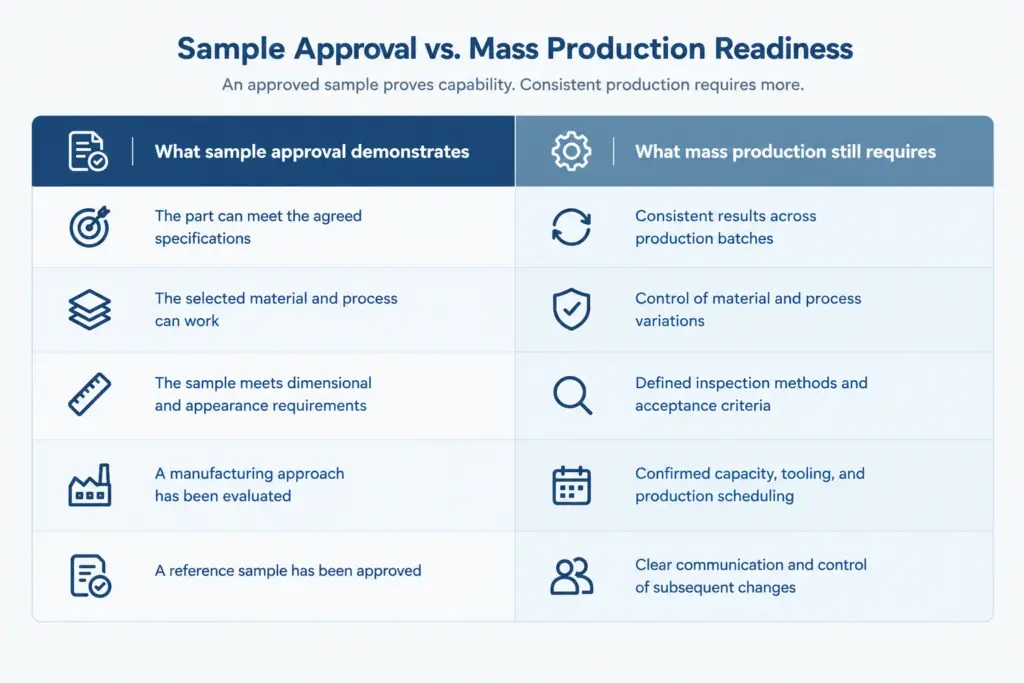
In OEM manufacturing, sample approval confirms that a part meets agreed requirements under the conditions used for sampling. However, an approved sample does not automatically guarantee consistent mass production. Before scaling up, OEM buyers should also consider production capacity, material and process consistency, inspection requirements, and supplier coordination where multiple processes are involved.
In OEM manufacturing, sample approval is an important milestone. It gives buyers the opportunity to evaluate a part, check it against the agreed specifications, and decide whether it is suitable before moving forward with a larger order.
But an approved sample does not automatically guarantee consistent mass production. A sample may meet every requirement when it is made, yet producing the same result across larger quantities can introduce new challenges.
Material batches may vary, tooling and machine conditions may change, and several suppliers or processes may need to work together. The objective is not simply to produce one acceptable part. It is to establish a process that can deliver parts meeting the same requirements repeatedly.
What Sample Approval Actually Confirms
Sample approval confirms that a part has been produced and evaluated against the agreed requirements under the conditions used for that sample.
It allows the buyer to assess the submitted part’s dimensions, material, appearance, and other specified characteristics. For example, a custom metal part may involve casting, CNC machining, welding, and surface treatment. The sample gives the buyer an opportunity to review the combined result, including critical dimensions, tolerances, material requirements, and finish.
When the sample passes the agreed evaluation, it provides evidence that the proposed manufacturing approach can produce an acceptable part. It may also reveal design or manufacturing issues before a larger quantity is committed.
However, sample approval confirms the result of the submitted sample. It does not, by itself, validate the repeatability of the full production process.
Why an Approved Sample Does Not Guarantee Consistent Production
The difference between producing an acceptable sample and maintaining stable production often becomes clearer as order quantities increase.
Several factors can affect whether the approved result can be reproduced consistently.
Repeatability Across Production Runs
A sample represents a limited number of parts produced at a particular time. Mass production requires the same specifications to be maintained across larger quantities and subsequent production runs.
Small variations in machining, forming, welding, or finishing may become more apparent as production volume increases.
The important question is not only whether a part can meet the specification once, but whether the manufacturing process can continue to meet it consistently.
Production Capacity and Scheduling
Producing a small sample and fulfilling a larger OEM order place different demands on a manufacturer.
Sampling may receive focused attention, while mass production must also account for machine availability, tooling, labor, production schedules, and other orders. If capacity and scheduling are not considered before production release, bottlenecks or extended lead times may affect delivery.
Sample approval alone does not confirm that the required quantity can be produced within the planned schedule.
Material and Process Consistency
Material batches and manufacturing conditions can influence the finished part.
Differences in material lots, tooling wear, machine settings, welding conditions, or surface treatment parameters may affect the result. These variations need to be managed against the agreed specifications and acceptance criteria.
This becomes especially important when a part passes through several manufacturing stages. If one supplier machines a part, another performs welding, and a third handles surface treatment, each stage must deliver an output that meets the requirements of the next.
Multiple Operators and Suppliers
A sample may be produced by one operator, on one machine, or by one supplier under closely managed conditions. Larger orders may involve different operators, production shifts, or additional manufacturing partners.
If drawings, specifications, and working requirements are not communicated clearly, different parties may interpret them differently.
An approved sample provides a useful reference, but everyone involved in production must also understand the documented requirements behind it.
A Practical Example: When Production Conditions Change
Consider a custom metal component that requires CNC machining, welding, and surface finishing.
The initial samples may meet the required dimensions, appearance, and functional specifications. However, when production quantities increase, additional factors may need attention.
Tooling wear can affect dimensional consistency. Welding conditions may influence part distortion. Surface finishing results may vary between production batches. Even when each manufacturing process is performed by a qualified supplier, the final result depends on how these processes are controlled and coordinated.
This is why an approved sample should be treated as a reference for production, rather than proof that every future batch will produce the same result.
What Should Be Confirmed Before Mass Production?
Before production begins, the approved sample should be supported by clear specifications and practical production arrangements.
Keeping a physical sample on file is useful, but it is not enough on its own. Understanding what OEM buyers should check before production release helps ensure all requirements are aligned before moving to mass production.
Approved Specifications and Reference Samples
The approved drawings and specifications should define the requirements that production parts must meet. Depending on the project, these may include material grade, critical dimensions and tolerances, surface finish, functional requirements, and other agreed details.
Drawing revision control is also important. If suppliers work from different or outdated documents, they may produce parts that do not match the latest requirements.
An approved physical sample can provide an additional reference for appearance, fit, or workmanship, but it should not replace documented specifications and acceptance criteria.
Inspection Methods and Quality Criteria
Buyers and suppliers should agree on which characteristics are critical, how they will be inspected, and what constitutes an acceptable result.
Dimensional inspection may require specific measuring equipment or methods, while appearance checks may depend on agreed finish standards and defect limits.
Depending on the project, first-article inspection, inspection records, or other verification activities may also be appropriate. Clear inspection criteria help ensure that different people evaluate parts against the same requirements.
Production Conditions and Quantity
The production plan should account for the required quantity, tooling arrangements, material availability, manufacturing capacity, lead time, and any secondary processes.
For parts involving several suppliers, the sequence and timing of each manufacturing stage should also be considered. A delay or quality issue at one stage can affect the operations that follow. Reviewing these conditions before production release helps identify potential constraints early.
Change Control
Changes may occur after sample approval. A drawing revision, material substitution, tooling adjustment, or change in the manufacturing process may affect the finished part. These changes should be communicated and evaluated before implementation.
Buyers and suppliers should agree on whether additional sampling, inspection, or customer approval is required. This helps prevent unapproved changes from entering production and maintains alignment with the agreed requirements.
From Approved Sample to Repeatable Production
Sample approval is one stage in a wider manufacturing process.
The transition to repeatable production involves confirming requirements, preparing production arrangements, manufacturing under planned conditions, and verifying the results.
- Sample: The part is manufactured and evaluated against the agreed engineering requirements.
- Production Release: Specifications, quality criteria, manufacturing arrangements, quantities, and other production requirements are confirmed.
- Production Run: The planned manufacturing process is applied to the required quantity under actual production conditions.
- Inspection: Parts are evaluated against established acceptance criteria, with inspection results documented where required.
- Repeatability: Subsequent production runs continue to meet the agreed requirements through consistent processes and appropriate follow-up.
These stages are connected.
If inspection identifies an issue during the first production run, the cause may need to be addressed before production continues. If material or process conditions change later, further verification may also be necessary.
The objective is not simply to obtain approval for the first batch. It is to establish a manufacturing process that can reliably deliver conforming parts over time.
How CASTALY Supports the Transition from Sample to Production
For OEM buyers, moving from an approved sample to mass production may involve multiple suppliers and manufacturing processes.
CASTALY Enterprise Corp. is a Taiwan-based OEM manufacturing integrator that coordinates custom manufacturing programs across multiple suppliers and production processes. Our role is not limited to identifying a factory capable of producing an acceptable sample. We also help coordinate the requirements and activities needed to support ongoing production.
Depending on the project, our coordination includes:
Supplier Alignment: Communicating approved drawings, specifications, revisions, and customer requirements across the suppliers involved.
Process Integration: Coordinating manufacturing sequences, material requirements, production quantities, lead times, and schedules.
Quality Oversight: Following up on agreed inspection requirements, quality results, and corrective actions when needed.
Production and Delivery Coordination: Monitoring manufacturing progress, identifying potential delays, and coordinating production and shipping arrangements.
For custom OEM components involving several manufacturing processes, this coordination helps maintain alignment between engineering requirements, supplier activities, and delivery commitments.
FAQs
How Can OEM Buyers Reduce Quality Risks When Working with Multiple Suppliers?
When different suppliers handle consecutive manufacturing processes, such as machining, welding, and surface treatment, quality issues may arise if requirements are not clearly communicated between stages.
OEM buyers can reduce these risks by defining inspection checkpoints, acceptance criteria, and handoff requirements before production begins.
Working with an OEM manufacturing integrator such as CASTALY can also help coordinate supplier communication, manufacturing requirements, and quality follow-up across multiple processes.
What Should Be Reassessed if an Engineering Change Occurs After Sample Approval?
When a drawing revision or design modification occurs after sample approval, its impact on existing tooling, materials, fixtures, inspection requirements, and production schedules should be reviewed.
Buyers and suppliers should confirm the applicable drawing revision and determine whether additional samples, inspections, or approvals are needed.
Where applicable, a formal Engineering Change Notice (ECN) process can help communicate changes and prevent different revisions from being mixed during production.
Sample Approval Is the Beginning of Production Confidence
An approved sample is an important milestone. It demonstrates that a part can meet the agreed requirements under the conditions used for sampling and provides a reference for subsequent production.
For OEM buyers, the next step after sample approval is to ensure that the approved requirements can be reproduced consistently throughout production.
A successful sample demonstrates capability. Consistent production demonstrates control.
Ready to Move from Sample Approval to Production?
Managing custom metal parts and multi-process manufacturing programs requires more than an approved sample. CASTALY helps OEM customers coordinate manufacturing requirements, suppliers, production, and quality expectations through our Taiwan-based manufacturing network.
Contact CASTALY to discuss your custom manufacturing project or learn more about our OEM manufacturing integration services.