
What OEM Buyers Should Check Before Production Release
A drawing has been approved. The quotation is accepted. The quantity is confirmed, and the supplier says production can begin. At first glance, everything appears ready for release.
But an approved drawing is only one part of production readiness. Before a part moves into manufacturing, engineering requirements, inspection criteria, production conditions, supplier readiness, and delivery requirements all need to be aligned.
For OEM buyers, this is the point where many avoidable production problems can either be prevented or allowed to develop. A production release should not simply confirm that the drawing is approved. It should confirm that the requirements needed to manufacture, inspect, and deliver the part have been reviewed and aligned.
When an Approved Drawing Is Still Not Enough
An approved drawing defines important requirements, but it does not always contain every piece of information needed for production.
A custom metal part may involve machining, material sourcing, heat treatment, surface finishing, welding, assembly, inspection, and packaging. Each step can depend on information that sits outside the drawing itself.
For example, a dimensional revision may affect machining instructions, welding fixtures, and inspection criteria. A material change may require a different supplier or adjustments to downstream processes. When multiple suppliers are involved, even a small engineering change needs to be communicated across the manufacturing process. Otherwise, one supplier may be working from the latest revision while another is still following earlier requirements.
This is why production readiness begins with engineering alignment. The objective is not simply to have an approved drawing, but to make sure the requirements can be understood and executed consistently.
When Everyone Needs to Work From the Same Information
Manufacturing involves multiple handoffs. Engineering may release a revision, purchasing may place the order, a supplier may begin production, and inspection may prepare the acceptance criteria. If one of these parties is working from an earlier version or incomplete information, the problem can appear much later in the process.
A drawing revision can be made in minutes, but implementing that revision may require updates to supplier instructions, tooling or fixtures, production planning, inspection criteria, and related documentation. Before release, the current revision and any changes to previously approved requirements should be communicated to all affected parties.
For OEM buyers, one practical question is therefore worth asking before release: Are all parties working from the same current information?
A Part Can Be Made Correctly — But How Will You Know?
Production readiness also depends on knowing how the finished part will be verified.
If a drawing identifies a critical dimension but there is no agreed inspection method or acceptance criterion, different parties may interpret the requirement differently. The part may be manufactured according to the drawing, yet the buyer and supplier may still disagree about whether it passes inspection.
Before production begins, buyers should identify which characteristics require inspection, how they will be measured, what constitutes acceptance, and whether a first article or sample approval is required. The approval status and any conditions or corrections identified during sample evaluation should be clear before the applicable production release.
First article approval confirms that the evaluated samples meet the agreed requirements within the scope of the approval. It does not automatically establish that every condition for repeat production is ready. Buyers should verify that approved requirements, inspection methods, and required corrections have been incorporated into the production process.
Inspection records can also become important when production involves multiple suppliers or repeated orders. Clear records provide a common reference for confirming that production requirements have been met.
A Supplier Can Make the Part. But Can They Make It When You Need It?
Supplier capability and production capacity are not the same thing.
A supplier may have the equipment, process knowledge, and technical capability to manufacture a part, but that does not necessarily mean a production slot is available when the order needs to run.
This is particularly relevant for smaller OEM orders. A smaller quantity does not always mean a shorter or easier production schedule. Setup, tooling, changeover, material preparation, and downstream processing may still require significant production time.
Before production release, buyers should therefore confirm not only whether a supplier can make the part, but whether the required quantity can be produced within the planned lead time and schedule.
Production Does Not End When the Part Comes Off the Machine
A production schedule can be technically on time while the shipment is still not ready.
Packaging, labeling, final inspection, shipment quantities, and delivery timing can all affect when finished parts are actually available to the customer. If these requirements are considered only after production is complete, the finished parts may have to wait for additional work before they can ship.
This is especially important for OEM programs with scheduled production, multiple shipment batches, or customer-specific packaging requirements. Delivery requirements should be part of production planning rather than treated as an afterthought.
The Production Release Is Really a Handoff
A production release is best understood as a handoff from planning into execution.
Engineering requirements need to reach purchasing and suppliers, with the correct revision and approval status clearly identified. Supplier activities need to align with production timing. Inspection needs to know what to verify and how to verify it. Packaging and delivery requirements need to be clear before finished parts are ready to ship.
When these handoffs are clear, teams spend less time waiting for missing information or clarification. When they are incomplete, production can be ready to move but still end up waiting for an engineering decision, material, supplier response, customer approval, or downstream process.
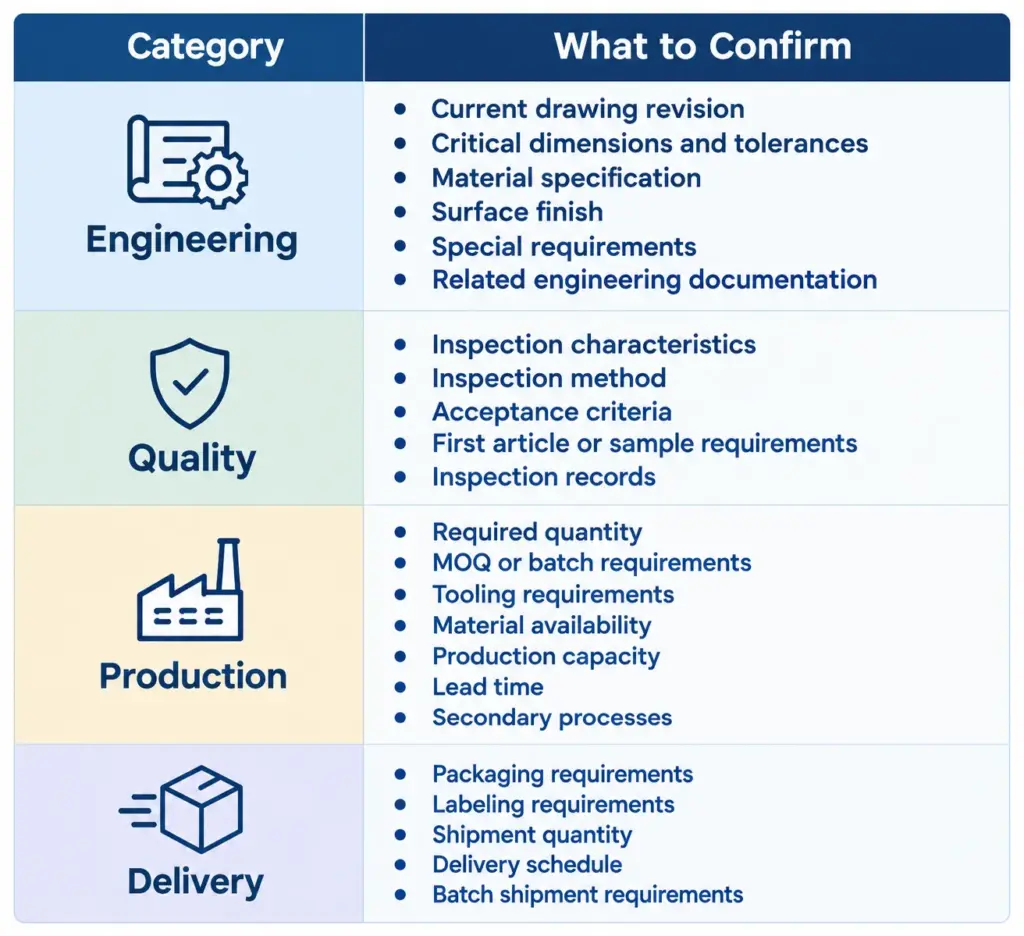
What Should Be Confirmed Before Production Release?
Before giving the final green light, OEM buyers should align with suppliers across four critical operational domains: Engineering, Quality, Production, and Delivery. In addition to the checklist below, confirm that drawing revisions have reached all affected suppliers, sample approvals and required corrections are documented, and tooling and downstream processes are ready for the planned production run.
Production Stability Starts Before Production Begins
Production stability is often discussed in terms of quality consistency, delivery performance, or repeatability. But those outcomes depend on what happens before the first production run.
Production stability does not begin when the machine starts running. It begins when the production requirements are clear enough for suppliers and internal teams to execute consistently.
If engineering requirements are incomplete, inspection criteria are unclear, materials are not available, supplier capacity has not been confirmed, or delivery requirements are still being clarified, production starts with uncertainty already built into the process.
A thorough production release helps remove that uncertainty. It gives engineering, suppliers, production, quality, and delivery teams a common set of requirements to work from.
How CASTALY Supports Production Readiness
As a Taiwan-based OEM manufacturing integrator, CASTALY coordinates multiple manufacturing processes and suppliers through a managed manufacturing network.
For custom metal components and assemblies, production may involve CNC machining, sheet metal fabrication, wire forming, welding, surface finishing, and other secondary processes. Each process needs to work from the same engineering requirements and production schedule.
CASTALY helps coordinate drawing revisions, supplier capabilities, production planning, quality requirements, and delivery arrangements across these processes. For OEM buyers, this provides a single point of contact for managing manufacturing activities across multiple suppliers, helping reduce coordination complexity as projects move from prototypes into production.
From Production Release to Repeatable Production
A well-prepared production release does not guarantee that every future production run will be problem-free. It does, however, establish the conditions needed for a controlled start.
The next question is what happens when the first parts are produced. Sample approval helps verify specified requirements, but its scope and timing depend on the OEM approval process. The transition to repeat production also requires consistent execution of the approved process and ongoing control of quality and delivery.
FAQs
Is an approved drawing enough to release production?
Not always. An approved drawing is essential, but production release should also confirm inspection requirements, material availability, production capacity, downstream processes, packaging, and delivery requirements.
How are sample approval and production release related?
Sample approval verifies that evaluated parts meet the agreed requirements within the scope of the approval. Production release authorizes manufacturing under defined requirements and conditions. Depending on the OEM’s process, sample approval may be required before production release, while some projects may permit controlled production under specified conditions.
What is the difference between supplier capability and production capacity?
Capability describes whether a supplier can technically manufacture the part. Capacity concerns whether the supplier can produce the required quantity within the requested schedule.
Can production start if some requirements are still being finalized?
It depends on the requirement. Non-critical details may sometimes be finalized during the project, but requirements affecting dimensions, materials, processes, inspection, or delivery should be clarified before production release to reduce the risk of rework or schedule disruption.
Why can a small engineering change create a production problem?
Because a change may affect more than the drawing. It can require updates to supplier instructions, purchasing information, production planning, inspection criteria, or related documentation.
Does production readiness guarantee stable mass production?
No. Production readiness reduces uncertainty before manufacturing begins, but stable mass production also depends on consistent process execution, quality control, supplier performance, and ongoing production management.
Conclusion
A strong production release creates a clear starting point for repeatable production. It gives suppliers and internal teams a common reference before the first production run and provides a foundation for managing quality, changes, and delivery throughout the OEM program.
For OEM buyers, taking the time to confirm these details before production begins can reduce avoidable clarification, waiting, rework, and schedule disruption later in the process.
The goal is not simply to start production. It is to start with the right information, the right process, and the right conditions in place.
If your OEM project involves custom metal components, multiple manufacturing processes, or coordination across several suppliers, CASTALY can help review your manufacturing requirements and support the transition from prototypes to production.
Contact CASTALY to discuss your drawings, production quantities, and manufacturing requirements.