OEM Manufacturing Integration in Taiwan: Simplifying Complex Production
For many OEM buyers, the challenge is not finding manufacturing capability. It is coordinating multiple suppliers, processes, and production requirements while keeping quality, lead time, and cost under control.
Complex OEM products rarely depend on a single manufacturing process. A finished component or assembly may require casting, CNC machining, welding, surface finishing, assembly, inspection, packaging, and international logistics.
Each process may perform well independently, but the overall program can still encounter delays or quality issues when schedules, specifications, engineering changes, and production requirements are not aligned. For OEM buyers sourcing custom metal parts from Taiwan, manufacturing coordination can therefore be just as important as manufacturing capability.
The Hidden Challenge Behind Complex OEM Manufacturing
When evaluating an OEM manufacturing partner, buyers naturally begin with manufacturing capability:
- Can they provide CNC machining or welding?
- Do they support casting, forging, or stamping?
- Can they handle fabrication, finishing, and assembly?
These questions matter. But manufacturing capability alone does not guarantee reliable execution. A multi-process OEM program also depends on how effectively each production stage connects to the next.
A machining delay may affect finishing. A drawing revision may affect multiple suppliers. A dimensional issue discovered during assembly may originate from an earlier manufacturing stage. As the number of processes and suppliers increases, these dependencies become more difficult for the OEM buyer to manage directly.
Common Challenges of Managing Multiple OEM Suppliers
Managing multiple suppliers can create operational risks that are easy to underestimate.
Scheduling Conflicts
If one supplier completes production later than expected, downstream processes may also be delayed. This can result in missed delivery schedules, production downtime, higher inventory costs, or expedited freight to recover lost time.
Quality Inconsistencies
Different suppliers may use different inspection standards, measurement methods, and quality control procedures. Without coordinated quality requirements, defects may remain undetected until a later production or assembly stage.
Communication Overload
OEM buyers may spend significant time following up on production progress, confirming specifications and schedules, and resolving issues across different suppliers.
What Is OEM Manufacturing Integration?
OEM Manufacturing Integration is an approach to managing multiple manufacturing processes, suppliers, quality requirements, and delivery activities as one coordinated production program.
Instead of requiring the OEM buyer to manage each supplier and process independently, a manufacturing integrator provides a central point of coordination across the production lifecycle. The objective is not simply to consolidate purchasing. It is to keep engineering information, production requirements, quality expectations, and schedules aligned across the manufacturing network.
Why Integrated Manufacturing Matters
For OEM buyers, reducing the number of supplier relationships is only part of the benefit. The greater value comes from improving coordination between engineering, production, quality, and delivery.
When these functions operate through one coordinated manufacturing structure, buyers gain better visibility while reducing the internal workload required to manage multiple production partners.
How Castaly Integrates OEM Manufacturing Projects
At Castaly, we coordinate custom metal parts and assemblies across a Taiwan-based manufacturing network. Our role spans the manufacturing lifecycle—from engineering review and supplier coordination through production, quality control, assembly, and final delivery.
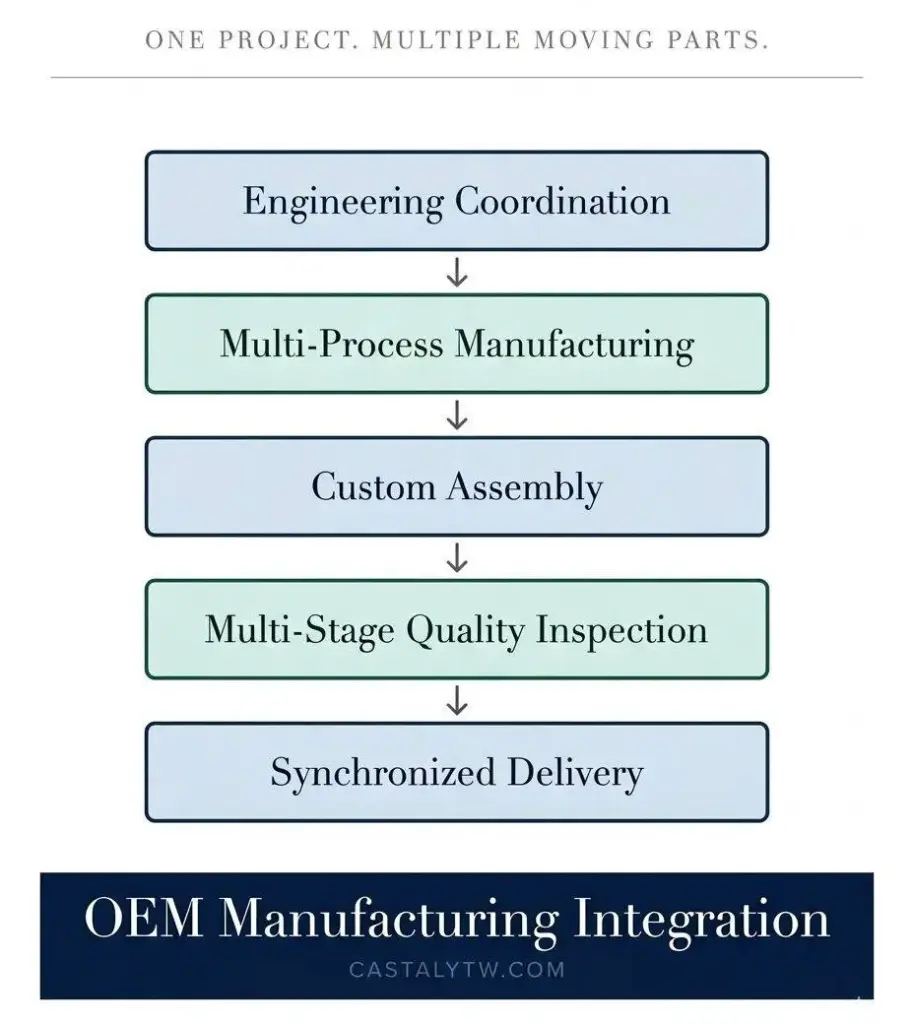
1. Engineering Coordination
Every successful project begins with clear technical communication. Our team works with manufacturing partners to ensure:
- Design requirements are clearly defined
- Manufacturing feasibility is verified
- Process compatibility is confirmed
Early engineering coordination helps identify potential manufacturing risks before they become costly production issues.
2. Multi-Process Manufacturing Management
Many OEM metal components and assemblies require more than one production method.
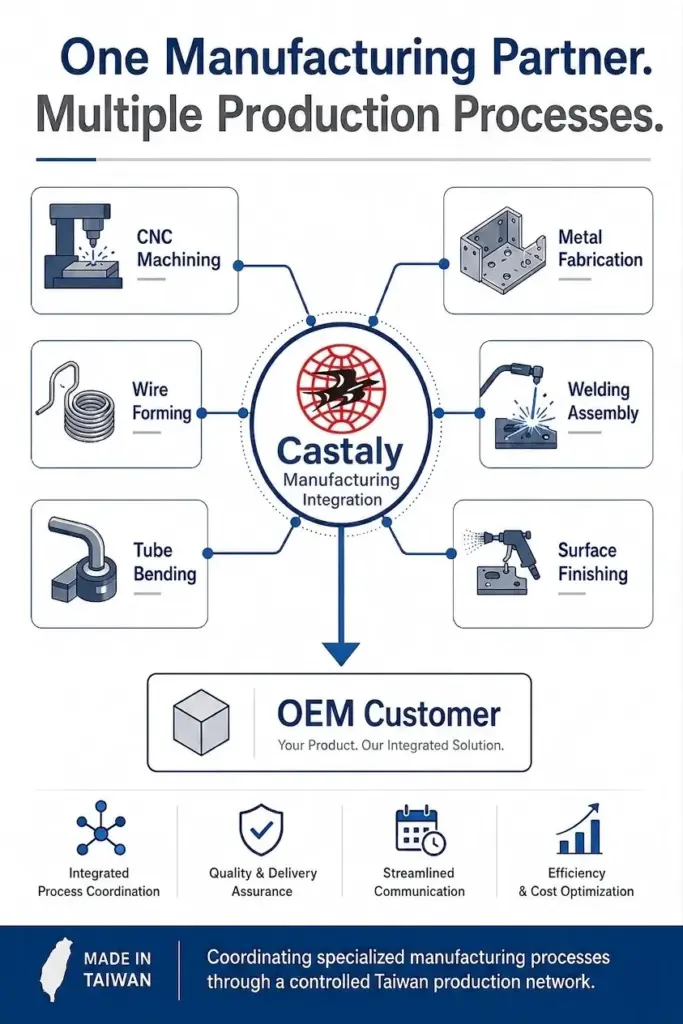
Depending on project requirements, manufacturing processes may include:
- Die Casting
- CNC Machining
- Metal Stamping
- Forging
- Wire Forming
- Tube Bending
- Metal Welding
- Surface Finishing
- Assembly
We manage these processes as interconnected production stages to reduce bottlenecks, improve workflow transitions, and maintain better control across the program.
3. Custom Assembly Solutions
Some OEM products require components manufactured through different processes or by different suppliers to be assembled into one finished product.
Coordinated assembly management helps:
- Reduce customer workload
- Improve component compatibility
- Minimize assembly errors
- Simplify inventory management
- Streamline final product delivery
This allows customers to receive a more complete solution instead of coordinating multiple incoming components independently.
4. Multi-Stage Quality Inspection
Quality control should not occur only at the end of production.
Depending on project requirements, inspections may be coordinated throughout the manufacturing process, including:
- Incoming material inspection
- In-process quality checks at each production stage
- Final quality control before shipment
Identifying issues earlier allows corrective action to be taken before defects affect downstream production or assembly.
5. Synchronized Delivery Management
Production is not complete until products arrive where they are needed.
Castaly coordinates production and delivery to help ensure:
- Production schedules align with shipping requirements
- Delivery timelines remain predictable
- Delivery risks are identified and managed as early as possible
Our goal is to keep each manufacturing stage aligned with the final delivery commitment.
From Prototype to Long-Term Production
Manufacturing integration becomes especially valuable as a project moves beyond initial development.
Castaly supports OEM programs from prototype development and first article validation through production ramp-up and ongoing supply. As requirements evolve, we coordinate engineering changes, supplier communication, production planning, quality requirements, and delivery schedules across the manufacturing network.
This provides OEM customers with continuity as a project moves from development into repeatable production.
FAQs
What should OEM buyers look for in a manufacturing partner for complex projects?
For complex OEM programs, manufacturing capability is only one consideration. Buyers should also evaluate engineering support, quality control, communication, production coordination, scalability, and the ability to manage multiple processes reliably.
A strong manufacturing partner should be able to explain not only how individual parts will be produced, but also how the complete production program will be managed.
Why is Taiwan a preferred location for OEM manufacturing?
Taiwan has a well-developed network of specialized manufacturers supporting processes such as machining, casting, forging, stamping, wire forming, fabrication, surface finishing, and assembly.
For OEM programs requiring several of these processes, this manufacturing ecosystem can support integrated production—provided the suppliers and production stages are effectively coordinated.
How can OEM buyers reduce supplier management workload?
Managing multiple suppliers can be time-consuming and increase production complexity. Working with a manufacturing coordinator can simplify communication, production management, quality follow-up, and logistics.
Castaly provides a single point of coordination across the manufacturing program, helping customers reduce the workload of managing multiple production partners.
What should OEM buyers prepare before requesting a quotation?
Providing engineering drawings, material specifications, estimated quantities, and project requirements allows Castaly to review the project, evaluate manufacturing feasibility, recommend an appropriate production approach, and prepare a more accurate quotation.
Why Choose Castaly?
Castaly operates as a Taiwan-based OEM manufacturing integrator, coordinating engineering, sourcing, production, quality control, and delivery across a multi-process manufacturing network.
Our role is to help OEM customers manage complex manufacturing programs through a single point of coordination—from prototype development and first article validation through production and long-term supply.
Rather than optimizing individual manufacturing processes in isolation, we focus on keeping the entire production program aligned. Successful OEM manufacturing depends not only on making the parts correctly, but on making every stage of the process work together.
Have a Complex OEM Manufacturing Project?
If your project involves multiple manufacturing processes, suppliers, or assembly requirements, Castaly can help evaluate the production approach and determine how the program could be coordinated through our Taiwan manufacturing network.
Contact our team to discuss your drawings, production requirements, and estimated volumes. You can also connect with our team on LinkedIn to learn how our integrated manufacturing approach can support your production goals.