OEM Manufacturing: Why Production Stability Matters Beyond Unit Price
When evaluating an OEM manufacturing partner, unit price is often one of the first numbers buyers compare. It matters, but it is only the starting point of a manufacturing program.
A supplier may offer a competitive quotation and produce an acceptable sample. The more important question is whether the same result can be maintained across repeated production runs, engineering changes, changing demand, and several manufacturing processes.
This is especially important for OEM programs that depend on more than one supplier or process. Machining, fabrication, welding, surface finishing, assembly, inspection, and packing may all need to stay aligned. A problem at one stage can affect the entire production sequence.
Production stability is the ability to keep that sequence under control over time. It gives OEM buyers more consistent quality, more predictable delivery, and a clearer view of the real cost of the program.
Unit Price Is Only One Part of Program Cost
The lowest quotation usually reflects the direct cost of making a part under a defined set of assumptions. It may not reflect the cost of managing the program when those assumptions are incomplete or when execution becomes more complex.
Additional costs can appear through:
- Engineering clarification and drawing revisions
- Tooling modifications and additional samples
- Rework, scrap, and corrective action
- Production delays and missed capacity windows
- Expedited freight
- Additional coordination across suppliers
These costs often appear after the sourcing decision, when requirements are clarified, volumes increase, or several processes must be coordinated. A small saving in unit price can disappear quickly if the program requires repeated intervention.
For this reason, quotations should be compared together with manufacturing scope, technical assumptions, lead time, quality requirements, and the supplier’s ability to support stable production.
Production Stability Starts With Engineering Alignment
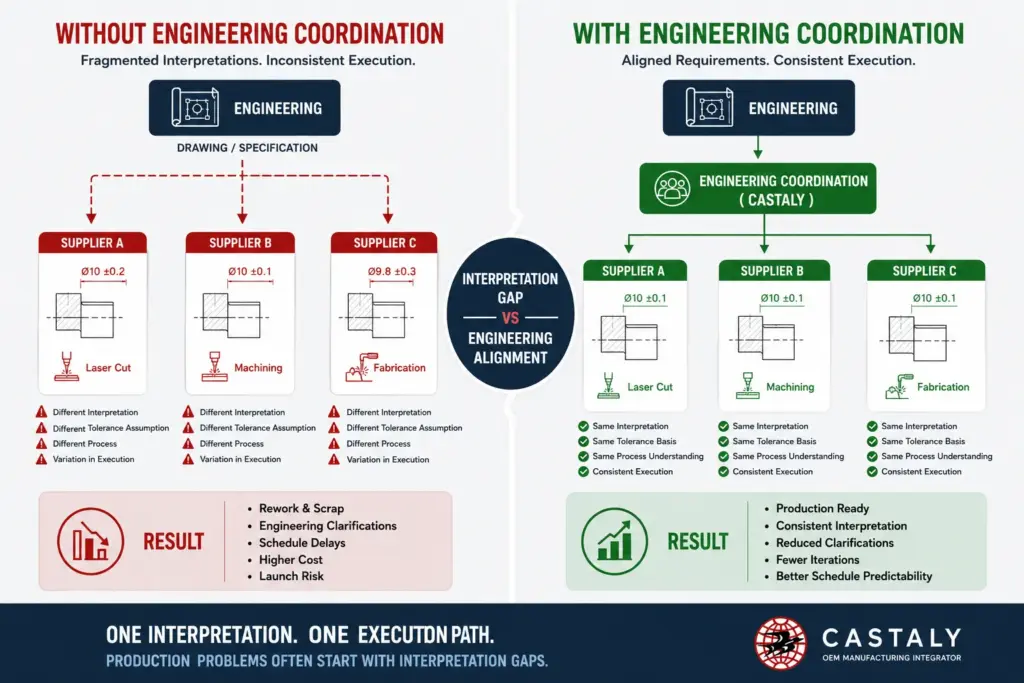
Many production problems do not begin on the shop floor. They begin with different interpretations of a drawing, an unclear tolerance, missing process information, or a design detail that is difficult to manufacture consistently.
If these issues are found late, the result may be another sample round, a tooling change, a material change, or a shifted production schedule. The later the issue is discovered, the more it can affect cost and lead time.
Before production release, the customer, manufacturing coordinator, and suppliers should share the same understanding of:
- Drawing revision and design intent
- Critical dimensions and tolerances
- Material and surface-finish requirements
- Inspection method and acceptance criteria
- Packaging, labeling, and delivery requirements
Early alignment does not remove every manufacturing risk, but it reduces avoidable uncertainty before materials, tooling, and capacity are committed.
Sample Approval Does Not Equal Stable Production
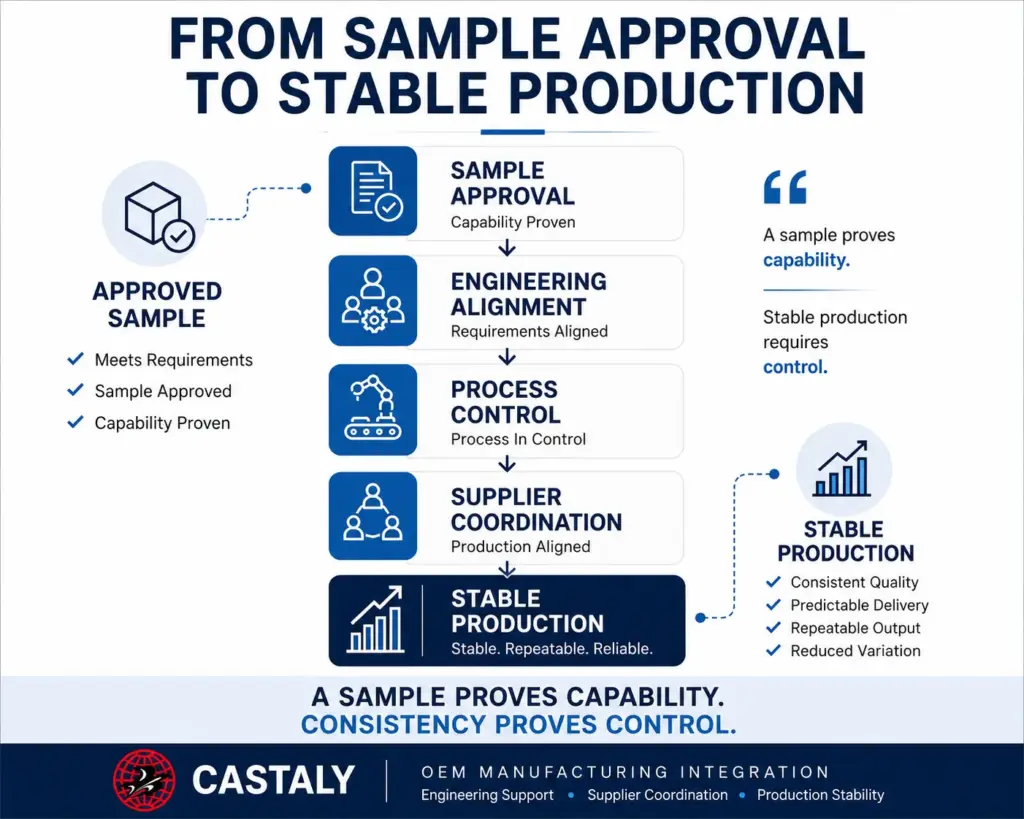
An approved sample is an important milestone. It confirms that a part can be manufactured to the agreed requirements under a specific set of conditions.
Production asks a different question: can the result be repeated when quantities increase, operators change, materials are replenished, schedules move, and engineering revisions are introduced?
After sample approval, stable production still depends on controlled specifications, repeatable processes, inspection discipline, change management, and clear communication. Without those controls, variation can enter gradually even when the first sample was correct.
A successful sample proves capability. Consistent production proves control.
Multi-Process Programs Need Active Coordination
In a multi-process OEM program, each supplier can be on schedule within its own operation while the overall program still falls behind.
For example, a machining delay may cause a planned welding slot to be missed. Welding then finishes later, surface treatment moves to the next available batch, and final assembly and shipment both shift. No single supplier caused the entire delay, but the dependency between processes was not protected.
Stable execution requires visibility across the complete sequence, including material readiness, batch sizes, supplier timing, available production slots, downstream capacity, inspection, and shipment planning.
This is where an OEM manufacturing integrator differs from a single factory or sourcing agent. The work is not limited to finding a supplier. It includes keeping several suppliers and processes aligned around one production plan.
What Stable Production Means for OEM Buyers
Production stability creates practical benefits for purchasing, engineering, operations, and service teams:
- More consistent quality across repeated production runs
- More predictable lead times and shipment planning
- Fewer corrective actions and emergency decisions
- Less dependence on expedited freight
- Better visibility for inventory and demand planning
- Stronger continuity when requirements or volumes change
These benefits are part of total cost of ownership. They may not appear in the initial piece price, but they directly affect the time, cost, and management attention required to keep an OEM program running.
How CASTALY Supports Stable OEM Manufacturing
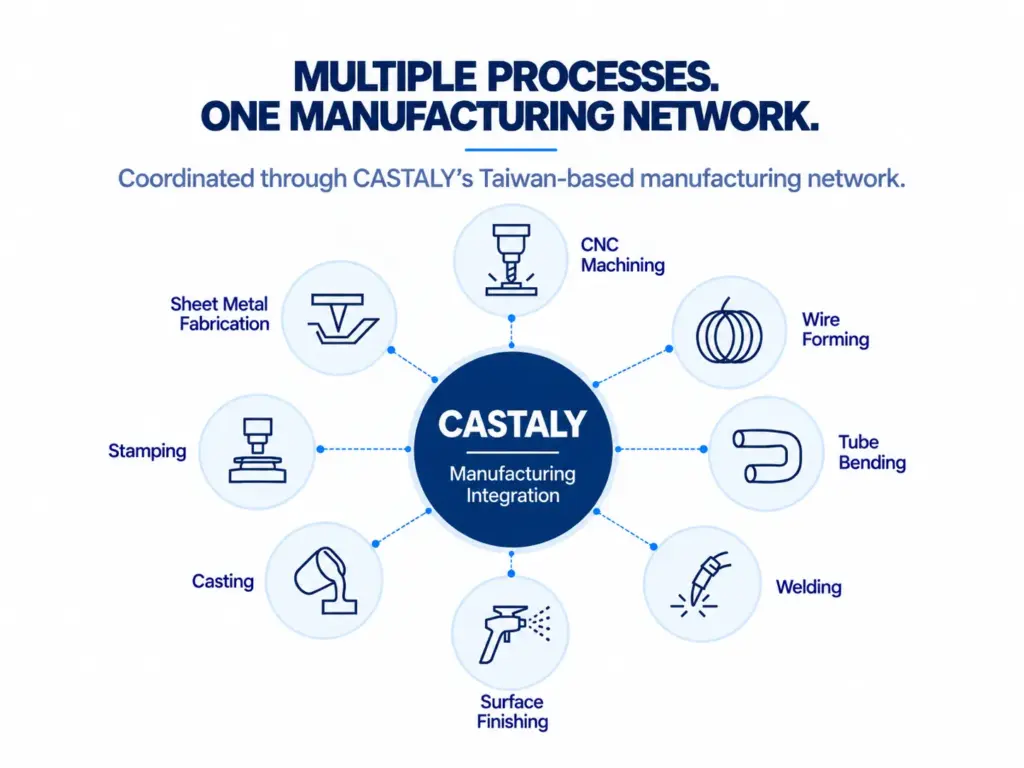
CASTALY operates as an OEM manufacturing integrator through a Taiwan-based manufacturing network. We coordinate the engineering, sourcing, production, quality, and logistics activities that need to remain connected throughout the program.
Before Production
We review drawings and manufacturing requirements with the relevant suppliers, clarify technical questions, evaluate manufacturability, and align expectations before production release.
During Production
We coordinate supplier timing and process sequencing across machining, fabrication, wire forming, tube bending, welding, casting, stamping, forging, surface finishing, and sub-assembly. We also track quality requirements and the dependencies that can affect downstream capacity and delivery.
Throughout the Program
When drawings, demand, schedules, or supplier conditions change, we help assess the impact across the production network and keep the customer informed. This gives the OEM one coordination point without losing visibility across the suppliers involved.
The objective is not simply to complete one order. It is to build a production system that can remain reliable as the program continues.
Production Stability Creates Long-Term OEM Value
Unit price remains important, but it does not show the full value or risk of an OEM manufacturing program. Engineering alignment, process control, supplier coordination, and change management all influence the final cost and delivery result.
The strongest manufacturing partner is not always the supplier with the lowest quotation. It is the partner that can help the program deliver the required result repeatedly, with fewer disruptions and better visibility over time.
FAQs
How should OEM buyers compare quotations from different suppliers?
Compare more than unit price. Review the material and finish assumptions, tooling, minimum order quantity, lead time, inspection requirements, packaging, shipping terms, and any work that is excluded. A consistent scope makes the comparison more meaningful.
Why is an approved sample not enough to confirm production stability?
A sample confirms that the part can be made under a specific set of conditions. Stable production also requires repeatable processes, controlled specifications, consistent inspection, and coordination as volumes, operators, materials, and schedules change.
When should supplier performance be reviewed?
Review performance after sample approval, during production ramp-up, after major engineering or volume changes, and following significant quality or delivery issues. Periodic reviews are also useful for long-term programs.
Discuss Your OEM Manufacturing Requirements
If your program involves multiple metal parts, manufacturing processes, or suppliers, CASTALY can help coordinate the work from engineering review and sampling through production and delivery.
Visit castaly or contact us on Linkedin to discuss your project requirements.