
What is Metal Welding?
When people hear the word “welding,” they often picture sparks flying as two pieces of metal fuse together. And that image isn’t wrong. Metal welding is the process of joining two or more pieces of metal into one solid piece by using heat, pressure, and sometimes filler material. Unlike temporary fixes such as gluing or soldering, welding creates a permanent bond that is designed to handle stress, heavy loads, and harsh environments.
There are two main categories:
- Fusion welding relies on heat alone to melt and fuse the metals, like MIG, TIG, or Stick welding.
- Pressure welding combines heat with heavy pressure to bond metals at or near their melting point.
No matter the technique, the goal is the same: a reliable, long-lasting joint that keeps machines, vehicles, buildings, and countless products safe and functional.
Metal Welding vs Metal Fabrication
It’s easy to confuse welding with fabrication, but here’s the difference: welding is one step within the bigger process of fabrication.
- Welding is focused on joining metals by melting their edges and sometimes adding filler material. It requires specialized tools like welding machines, shielding gases, and protective gear. Welders need to master different methods, such as MIG, TIG, or Stick, and safety training is essential. In terms of cost and time, welding is often faster and cheaper for simple joining or repair tasks, though precision projects can become more expensive and time-consuming.
- Fabrication, on the other hand, is the full process of turning raw metal into a finished product. It involves cutting, bending, shaping, and then assembling parts. Fabricators use a wider range of machines, such as cutting torches, press brakes, and assembly tools. Because fabrication covers multiple stages, it usually takes more time and comes with higher costs compared to standalone welding. The skill set is also broader, since fabricators need to understand not just welding, but also how to shape and prepare materials from start to finish.
Common Applications of Metal Welding
Welding touches more parts of our daily lives than most people realize. Here are some of the key industries where welding plays a starring role:
- Construction and Infrastructure: From skyscrapers and bridges to pipelines and structural beams, welding ensures the backbone of our cities is strong and secure.
- Automotive and Transport: Car bodies, exhaust systems, train cars, and even aircraft frames all rely on welding. Without it, modern transportation wouldn’t exist.
- Heavy Equipment and Mining: Bulldozers, tractors, and mining machines often require both fabrication and repair welding to keep them working in tough conditions.
- Aerospace: Precision is everything in this field. TIG welding is especially popular because it produces clean, high-quality welds for lightweight materials like titanium and aluminum.
- Marine and Shipbuilding: Ships, submarines, and offshore platforms need welds that resist corrosion and can withstand salty, high-pressure environments.
- Oil, Gas, and Power Generation: Pipelines, storage tanks, and power plant components depend on welding for both construction and ongoing maintenance.
- Industrial Manufacturing: From metal shelving and machinery frames to food processing equipment, welding keeps production lines running.
- Medical and Food Processing: Stainless steel welds are common here, offering strength and hygiene for implants, surgical tools, and clean processing equipment.
- Art and Sculpture: Beyond industry, welding is also a creative tool. Artists use it to craft steel sculptures, public art installations, and custom metalwork.
How Metal Welding Works: Process
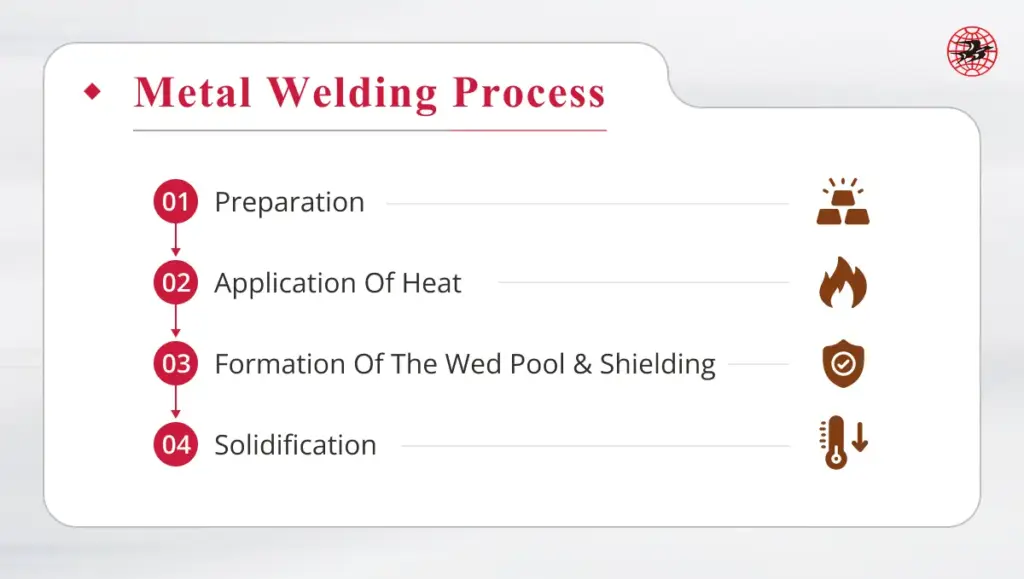
Welding may seem simple as melting and joining two pieces of metal, but in reality, it follows a careful sequence of stages. Each step plays a critical role in ensuring the final joint is strong, durable, and safe to use. Let’s see how the welding process works:
Preparation
Before striking an arc or applying heat, welders make sure the base metals are clean and free from dirt, rust, grease, or paint. Even the smallest contaminant can weaken the bond and cause defects.
Once the surfaces are spotless, the metals must be carefully aligned and shaped into the intended joint configuration, whether it is a butt, lap, corner, or T joint. This step, often called fit-up, is crucial for achieving precision and strength once the weld is complete.
Application of Heat
After the workpieces are ready, the welding process moves to the application of heat. Depending on the technique and materials, the heat source may come from an electric arc, a gas flame, a laser, or even friction.
The purpose is to raise the temperature of the joint area until the base metals either soften or melt. This controlled heating allows the metal edges to become malleable enough to fuse, setting the stage for the formation of a permanent joint.
Formation of the Weld Pool and Shielding
When the metals reach the right temperature, a molten weld pool forms at the joint. This is the heart of the welding process, where the actual fusion takes place.
In many methods, a filler material such as a wire, rod, or electrode is introduced into the molten pool to reinforce the joint and improve its strength. Depending on the project, the filler can be identical to the base material, different from it, or omitted altogether.
At the same time, welders must protect the molten metal from contamination by the surrounding atmosphere. Shielding gases like argon or helium, or flux coatings used in processes such as stick welding, create a barrier that prevents oxygen and nitrogen from weakening the weld.
Solidification and Post-Welding
Once the weld pool has been created and properly shielded, the final step is solidification.
As the heat source is removed, the molten metal cools and hardens into a solid joint. For certain materials, such as cast iron, controlled slow cooling is needed to prevent cracks or stress fractures.
After the weld has set, additional finishing work may be required. This can include grinding for a smooth surface, stress-relieving treatments to enhance durability, or simply removing the slag layer left behind by flux-based processes. These post-welding tasks ensure not only the strength of the weld but also its appearance and long-term performance.
Main Types of Welding Techniques
Arc welding is one of the most widely used methods in metalworking. It uses an electric arc to generate heat, melting the base metals and, in most cases, a filler material to form a strong and permanent bond. Within arc welding, there are several techniques, each with its own strengths and applications. Let’s look at the most common ones: MIG, TIG, Stick, FCAW, and SAW welding.
MIG Welding (Gas Metal Arc Welding, GMAW)
MIG welding, short for Metal Inert Gas welding, is one of the easiest methods to learn and is widely used in many industries. In this process, a continuous solid wire is fed through a welding gun. When the trigger is pressed, an electric arc forms between the wire and the workpiece, melting the wire and fusing it into the joint. An inert shielding gas, often argon or a mix of argon and carbon dioxide, flows out of the gun to protect the weld from oxygen and nitrogen in the air.
The big advantages of MIG welding are its speed and ease of use, which make it especially appealing to beginners. It is versatile enough to work on mild steel, stainless steel, and even aluminum. Because of these qualities, MIG welding is popular in the automotive industry for car frames and exhaust systems, and in construction for beams and sheet metal.
Note that MIG welding is a type of GMAW process. GMAW is the formal industry term for arc welding with a continuous solid wire and shielding gas. MIG welding specifically refers to GMAW setups that use fully inert gas to protect the weld, and the name is often used as everyday shorthand for this welding style.
TIG Welding (Gas Tungsten Arc Welding, GTAW)
TIG welding, also known as Gas Tungsten Arc Welding, is often chosen when precision and quality matter most. Instead of a consumable wire, TIG uses a non-consumable tungsten electrode to create the arc. If extra strength is needed, the welder manually feeds a separate filler rod into the molten pool. Like MIG, a shielding gas such as argon or helium protects the weld from contamination.
TIG welding takes more practice to master and is slower compared to MIG, but the results are worth it. The process produces extremely clean, accurate welds with no spatter or slag, making it ideal for industries like aerospace, medical devices, food processing, and artwork fabrication.
Want to know more? Check our guide about the differences between MIG and TIG!
SMAW Welding/Stick Welding (Shielded Metal Arc Welding)
Stick welding is one of the oldest and most straightforward forms of welding. Instead of a wire feed, it uses a consumable electrode coated in flux. As the electrode melts, the flux burns away, releasing a protective gas and leaving behind a slag coating that shields the weld while it cools.
One of the biggest advantages of stick welding is portability. Because it doesn’t require bottled gas, it can be used virtually anywhere, including outdoors or in remote areas where conditions may be less than ideal. It is widely used in construction, heavy-duty structural work, pipelines, and maintenance or repair jobs on farm equipment and machinery. The trade-off is that once the weld cools, the slag must be chipped away, which adds extra cleanup time.
FCAW Welding (Flux-cored Arc Welding)
Flux-Cored Arc Welding, or FCAW, is similar to MIG in that it uses a wire fed through a gun, but instead of a solid wire and external gas, the electrode is a tubular wire filled with flux. When the flux melts, it creates both gas and slag shielding, which protects the weld pool. This makes FCAW highly suitable for outdoor work, where wind would interfere with traditional shielding gases.
FCAW is known for high welding speeds and strong penetration, making it excellent for thick materials. It is commonly used in construction, shipbuilding, and heavy equipment manufacturing. Specialized flux-cored wires are also used in reclamation welding to rebuild worn parts such as shafts and crusher components. The only downside is that FCAW tends to produce more spatter, so extra cleanup may be required.
SAW Welding (Submerged Arc Welding)
Submerged Arc Welding, or SAW, is often used in heavy-duty applications where efficiency is critical. In this process, the electric arc burns beneath a thick layer of granular flux. The flux completely covers the arc, which prevents spatter and protects the weld from atmospheric contamination.
Because of its design, SAW can achieve deep penetration and produce high-quality welds on thick materials, often in a single pass. The process is usually automated and is common in industries like shipbuilding, offshore platform construction, pressure vessel manufacturing, and other large-scale structural projects. It’s not a method for small or portable jobs, but when it comes to speed and quality on heavy materials, SAW is hard to beat.
| Welding Method | Process & Shielding | Advantages | Common Applications | Considerations |
| MIG (GMAW) | Continuous solid wire with shielding gas (argon/CO₂ mix). | Easy to learn, fast, versatile. | Automotive, construction, fabrication, aerospace, and shipbuilding. | Not ideal outdoors; shielding gas can be blown away. |
| TIG (GTAW) | Non-consumable tungsten electrode, optional filler rod, shielding gas. | High precision, clean welds, no spatter. | Aerospace, medical, food processing, and artwork. | Slower process, requires high skill. |
| Stick (SMAW) | Consumable flux-coated electrode; flux creates gas and slag shielding. | Portable, no bottled gas needed, works outdoors. | Construction, pipelines, structural steel, repairs. | Slag must be removed; slower cleanup. |
| FCAW | Tubular flux-filled wire; flux provides gas and slag shielding. | Fast, strong penetration, works in windy conditions. | Construction, shipbuilding, heavy equipment, and reclamation welding. | Produces more spatter; extra cleanup needed. |
| SAW | Arc submerged under a granular flux layer, usually automated. | Highly efficient, deep penetration, high-quality welds. | Shipbuilding, offshore platforms, pressure vessels, heavy structures. | Limited to large, industrial applications; not portable. |
Common Metal Materials for Welding
The success of any welding job depends not only on the technique, but also on choosing the right base metal. Each material reacts differently to heat because of its thermal conductivity, melting point, and expansion rate. The wrong choice can lead to weak joints, wasted time, and higher costs. Below are the most common metals for welding, along with what makes each unique and how they are best welded.
Steel (Mild Steel and Carbon Steel)
Steel is by far the most common material in welding. Mild steel, a type of carbon steel, is affordable, strong, and easy to weld with almost any process. Its flexibility makes it the go-to choice for everything from car parts to construction beams. The most common steel welding techniques are MIG and Stick. The main challenge is rust, which must be cleaned off to avoid weak welds.
Stainless Steel
Stainless steel stands out for its corrosion resistance and durability. Thanks to the chromium content, it performs well in harsh environments like marine, medical, and food processing. TIG and MIG welding are usually preferred because they produce clean, precise welds. However, stainless steel holds heat poorly, which means it can warp or lose some of its corrosion resistance if overheated. Welders must work carefully to control heat.
Aluminum
Aluminum is lightweight yet strong, making it vital for aerospace, automotive, and marine work. It conducts heat quickly and melts at a lower temperature than steel, which means welders must work fast and with precision to avoid burning through. TIG welding with AC is often the best choice, though MIG can also be used. Before welding, the thin oxide layer on aluminum must be removed because it melts at a much higher temperature than the metal underneath. If the oxide layer is not removed, it may result in a weak, porous weld or even burn-through, as the base aluminum melts first.
Cast Iron
Cast iron is tough but brittle, which makes it tricky to weld. It is commonly found in engine blocks, machine bases, and piping systems. To prevent cracking, welders often preheat the metal, use nickel-based electrodes, and cool it slowly after welding. Surface cleaning is also critical. In some cases, oxyacetylene welding is used, though specialized approaches are required for reliable results.
Copper
Copper is prized for its excellent electrical and thermal conductivity. It is used in electrical wiring, plumbing, and heat exchangers. Alloys like bronze and brass expand their range of applications. TIG and MIG welding work well for copper, but because it conducts heat so effectively, welders must use higher heat input to keep the weld pool stable. The good news is that most copper alloys do not require preheating.
Nickel
Nickel is essential in industries where materials face extreme heat or aggressive chemicals, such as power plants, refineries, and aerospace turbines. Nickel alloys combine strength and corrosion resistance at high temperatures, making them ideal for mission-critical parts. TIG and MIG welding are the most common methods, usually with carefully matched filler materials to preserve performance.
Titanium
Titanium has an outstanding strength-to-weight ratio and is highly resistant to corrosion. It’s widely used in aerospace, marine engineering, and medical implants. However, titanium is extremely reactive when hot, which means even small amounts of contamination can ruin a weld. TIG welding with strict shielding gas protection (argon or helium) is required to produce high-quality results.
Magnesium
Magnesium is even lighter than aluminum and has excellent vibration-damping qualities, making it popular in automotive, aerospace, and electronics. Its downside is that it is highly flammable, especially when in dust or shaving form. Special care must be taken, as water cannot be used to extinguish magnesium fires. TIG welding is the most common method, though friction stir and laser welding are also used for advanced applications.
| Material | Key Characteristics | Common Applications | Best Welding Methods |
| Mild & Carbon Steel | Affordable, strong, easy to weld | Construction frameworks, automotive parts | MIG, Stick |
| Stainless Steel | Corrosion-resistant, durable, strong | Food processing, marine, medical, and pharmaceutical | TIG, MIG |
| Aluminum & Alloys | Lightweight, corrosion-resistant, high conductivity | Aerospace, automotive, HVAC, marine | TIG (AC), MIG |
| Cast Iron | Strong but brittle, high carbon content | Engine blocks, machine bases, piping | Oxyacetylene, Stick with nickel electrodes |
| Copper & Alloys | Excellent electrical & thermal conductivity | Electrical wiring, plumbing, and heat exchangers | TIG, MIG, brazing |
| Nickel & Alloys | Heat- and corrosion-resistant in extremes | Power plants, refineries, turbines, aerospace | TIG, MIG |
| Titanium & Alloys | High strength-to-weight, corrosion-resistant | Aerospace, marine, and medical implants | TIG (argon/helium shielding) |
| Magnesium & Alloys | Very lightweight, vibration-damping | Automotive, aerospace, electronics | TIG, laser, friction stir |
| Tungsten (electrode material) | Very high melting point, stable arc | Used in TIG and plasma arc welding | TIG electrode use |
Castaly Delivers Precision Welding Parts Tailored to Your Needs
From understanding the basics of welding to exploring the different techniques and materials, one thing is clear: welding is the backbone of modern manufacturing and construction. Whether it’s joining mild steel for a building frame, creating flawless TIG welds on stainless steel, or tackling heavy-duty projects with flux-cored methods, the process demands both precision and expertise. Choosing the right approach and the right partner makes all the difference in achieving durable, reliable results.
At Castaly, we know that precision and strength are non-negotiable. Our welding service delivers consistent quality across every part and product we produce. With skilled technicians, advanced equipment, and strict quality control, we ensure consistent, high-quality results in every part.
Whether you need custom welding parts, metal parts, wire-formed parts, or large-scale production, Castaly offers the experience, flexibility, and on-time delivery to support your project at affordable costs. As a one-stop solution for offshore metal parts purchasing, we handle everything from sourcing to delivery, ensuring a seamless and worry-free process. Our ability to manage complex assemblies and meet unique specifications with higher standards makes us the trusted partner for businesses that value both quality and efficiency.
Curious about the right manufacturing partner? See why so many brands trust Castaly.
Send us your drawings or product ideas, and we’ll deliver a precise quotation plus expert guidance on materials, production methods, and timelines. Contact us to discuss your needs, or connect with our team on LinkedIn. Let’s bring your concept to life and build a partnership that supports your growth for the long run.