
Choosing the right welding method can feel tricky, especially when tackling projects like auto body repairs, custom metal furniture, or heavy-duty fabrication. The mig and tig difference often creates confusion, making it hard to pick the right approach. Without a clear understanding, you might waste materials or end up with weak joints. This article explains mig welding advantages, TIG benefits, and guides you toward the best welding process for your project, whether it’s quick repairs or precision builds.
What is the MIG Welding Process (Gas Metal Arc Welding)
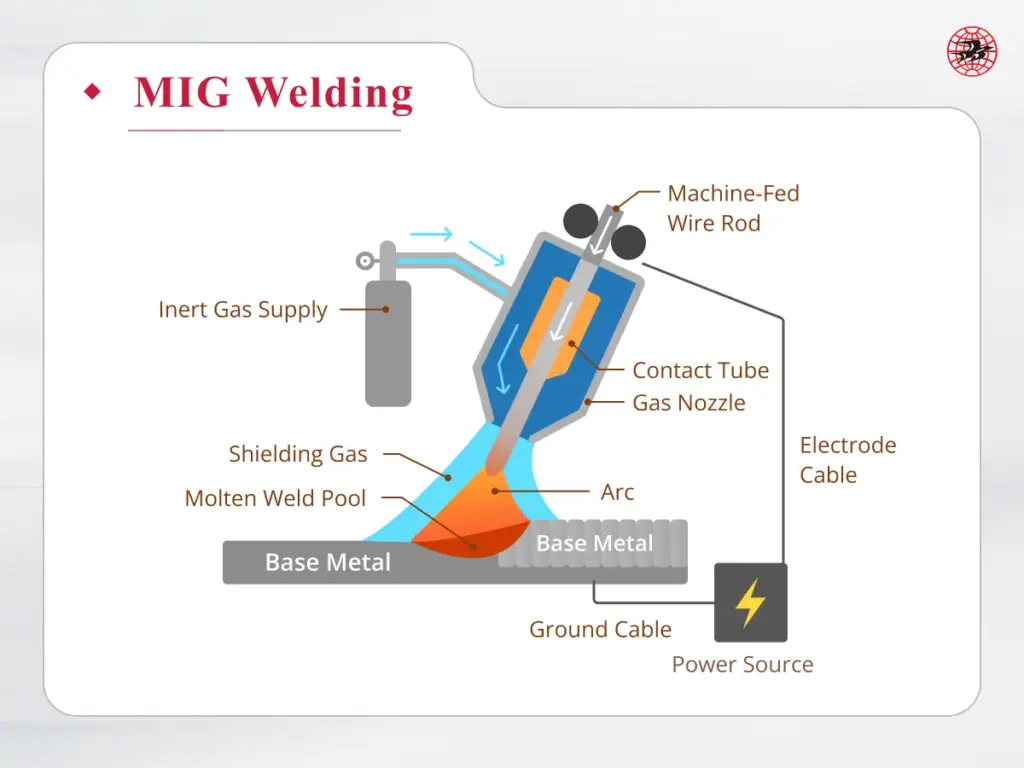
MIG welding, or Metal Inert Gas welding and Gas Metal Arc Welding, is one of the most widely used welding techniques in both workshops and large-scale manufacturing. The process is straightforward, making it popular among beginners and professionals alike. MIG involves feeding a continuous wire electrode through a welding gun. This wire acts as both the electrode, creating the arc, and the filler material, which melts and joins the metals together.
Because the wire is automatically fed, MIG welding allows the welder to operate with one hand, making it easier to work in awkward positions or on longer welds. A direct current(DC) power source is commonly used, which provides a steady arc and is effective on thinner metals.
At the same time, shielding gas flows through the gun to protect the weld pool from contamination. Without this shielding, oxygen or nitrogen in the air could cause weak spots or porosity. Argon and carbon dioxide mixtures are the most common gases used, though specific blends can be chosen depending on the job.
MIG welding is valued for its speed, cost-effectiveness, and versatility. It works well on common materials like mild steel, stainless steel, and aluminum, and it is often used for thicker sections of metal. However, the process also has limits.
Because it generates a lot of heat, it can burn through thin metals. The welds often require grinding to achieve a smooth finish, and the shielding gas makes it difficult to use outdoors, especially in windy conditions.
Pros of MIG Welding:
- Fast and efficient for high-production jobs
- Cost-effective with affordable equipment and consumables
- Easy to learn and suitable for beginners
- Works on a wide range of metals and thicker materials
Cons of MIG Welding:
- Welds may lack the precision or clean appearance of TIG
- High heat can damage thin materials
- Shielding gas is unsuitable for outdoor conditions
- Welds can suffer from porosity or defects if the surfaces are not clean
What is the TIG Welding Process (Gas Tungsten Arc Welding)
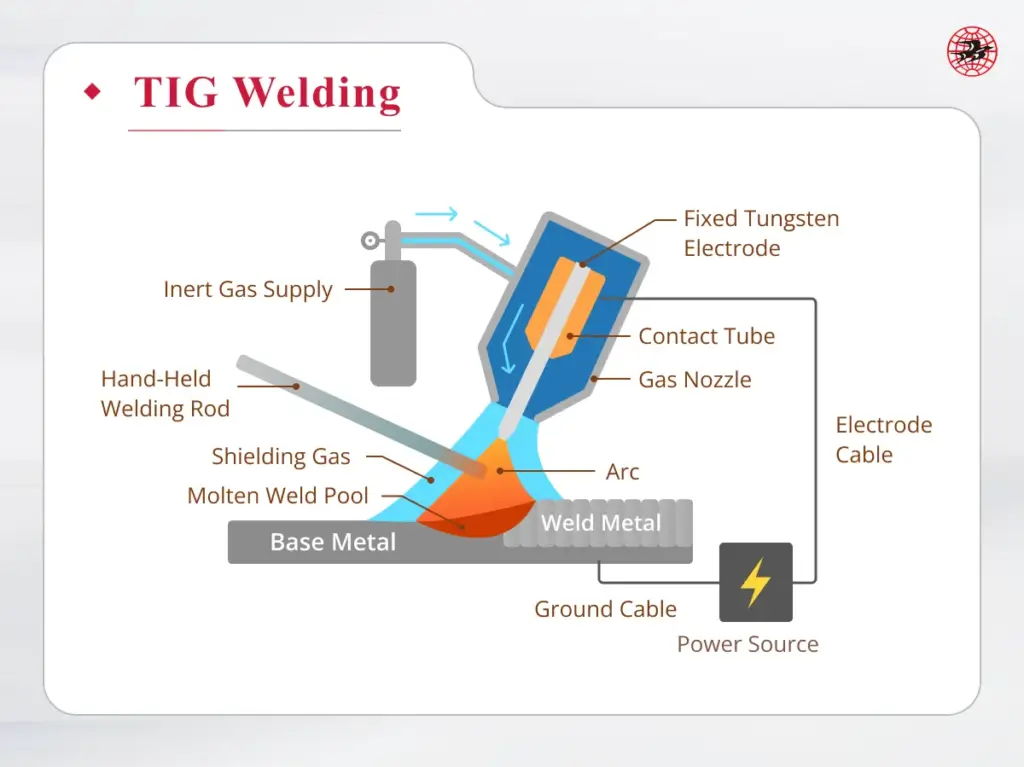
TIG welding, also known as Gas Tungsten Arc Welding (GTAW), is recognized for delivering some of the most precise welds in the industry. It uses a non-consumable tungsten electrode to create the arc, while the welder manually adds a filler rod as needed. Many welders also use a foot pedal to adjust amperage, giving fine control over the heat and allowing for extremely accurate welds. This two-handed approach makes TIG ideal for projects requiring meticulous craftsmanship.
One of TIG’s major advantages is its ability to handle a wide variety of metals. TIG machines can operate on DC or AC, allowing them to weld steel, stainless steel, aluminum, titanium, and copper alloys. AC is particularly useful for aluminum, as the AC cleans the oxide layer that would otherwise interfere with a strong weld.
TIG also uses shielding gas, usually pure argon, to protect both the electrode and molten metal from contamination. The result is exceptionally strong welds with a smooth, visually appealing finish. For this reason, TIG is the preferred method for high-quality applications, such as custom automotive parts, aerospace components, and food-grade stainless steel equipment.
The precision and quality of TIG welding come with trade-offs. It requires a high skill level and steady coordination, and the base materials must be purely clean to prevent defects. Equipment costs are higher, and the process is slower, making it less practical for large-scale or high-speed production.
Pros of TIG Welding:
- Produces strong, precise, and high-quality welds
- Creates clean, attractive welds with minimal spatter
- Versatile across many metals, including thin and specialty materials
- Allows excellent control with filler rod and foot pedal
Cons of TIG Welding:
- Less efficient for big jobs
- Requires more expensive equipment and consumables
- Steeper learning curve, not beginner-friendly
- Demands clean base metals for best results
Key Differences Between MIG and TIG Welding
MIG and TIG welding both use an electric arc to fuse metals, but the way they work and the results they deliver are very different. Below is a factor-by-factor comparison to help you clearly see the MIG and TIG difference and decide which process is right for your job.
Skill Level
MIG welding is straightforward. Many beginners become comfortable with it in just a few practice sessions. The point-and-shoot style makes it easier to create acceptable welds quickly, which is why it’s widely taught in schools and used in general repair work.
TIG welding demands more expertise. The operator must control the arc, filler rod, and heat simultaneously. A shaky hand or wrong heat setting can ruin a weld. For this reason, TIG welders typically need extensive training and experience, making them less accessible for casual users.
Speed and Production
MIG welding is fast, often two to three times quicker than TIG. The continuous wire feed allows for long, uninterrupted welds, which boosts productivity. In manufacturing settings where hundreds of joints need welding, MIG is the clear choice to save time and reduce costs.
TIG welding is slower and deliberate. Each weld requires focus, coordination, and precise control, which increases production time. While this limits TIG’s use in mass production, it shines in applications where detail and quality matter more than speed.
Cost
MIG machines are generally less expensive, and the wire electrodes are affordable. Its faster welding speed lowers labor costs, and beginners can produce reliable results with minimal training.
TIG equipment is more costly, and consumables like tungsten electrodes and filler rods are pricier. The slower welding pace also increases labor expenses. On top of that, TIG usually requires skilled operators who command higher wages. All these factors make TIG welding costlier per weld.
Weld Quality, Strength, and Appearance
MIG welds are functional and strong enough for many heavy-duty uses, but they often lack refinement. The fast process creates more spatter, rougher surfaces, and sometimes harder, brittle joints that may need grinding afterward.
TIG welds are prized for quality. They are cleaner, smoother, and structurally stronger with fewer defects. The slower process allows for deeper penetration and a “stacked-coin” appearance that many industries value for both strength and aesthetics. TIG welds also cool more gradually, which reduces brittleness.
Shielding Gas
MIG welding generally uses a blend of argon and carbon dioxide (commonly 75/25). The CO2 helps improve penetration and arc stability. However, because CO2 is reactive, it can cause more spatter. MIG welding is best done indoors since wind can easily disrupt the shielding gas.
TIG welding relies almost entirely on pure argon, which provides a stable, inert shield for both the weld and the tungsten electrode. Helium or other gases can be added for special applications. Since tungsten is sensitive, the gas must be very clean, adding to the process’s cost.
Suitable Materials and Thickness
MIG welding works best on thicker materials, from sheet metal to structural steel plates. It handles mild steel, stainless steel, and even cast iron. Because the process feeds filler automatically, it can also bridge gaps, making it more forgiving of imperfect fit-ups.
TIG welding excels at thin materials, where precise heat control prevents warping or burn-through. It is highly versatile with metals such as stainless steel, aluminum, copper, brass, titanium, and exotic alloys. This makes TIG a go-to for industries like aerospace and motorsports that deal with advanced materials.
Welding Applications
MIG is the practical choice for general fabrication, automotive repairs, heavy construction, and high-production work where efficiency and lower cost are priorities. Its ability to weld in awkward positions with one hand also makes it popular for on-site repairs.
TIG is preferred in situations where weld quality and appearance are critical. This includes aerospace components, custom car parts, food-grade stainless steel equipment, decorative metal art, and precision tubing. While slower, it produces results that meet the highest standards for durability and aesthetics.
What about Stick Welding (Shielded Metal Arc Welding)?
Shielded Metal Arc Welding (SMAW), commonly known as stick welding, is one of the oldest and most widely used arc welding methods. Instead of using a separate shielding gas, SMAW uses a consumable electrode coated in flux. As the electrode melts, its flux coating generates shielding gases and forms a protective slag over the molten weld, preventing contamination. After the weld cools, the slag must be removed before the joint is finished or before additional weld passes can be made.
One of SMAW’s biggest advantages is its simplicity. The setup requires only a power source, an electrode holder, a ground clamp, and electrodes. There’s no need for gas cylinders, making it highly portable and practical for outdoor or remote environments. This portability, combined with its ability to handle rusty, dirty, or weathered surfaces, makes SMAW a go-to choice for construction, pipeline work, and repair jobs.
However, stick welding has drawbacks compared to MIG and TIG. It is slower, noisier, and less efficient. The process produces more fumes and spatter, and the need to replace electrodes and remove slag between welds adds time. The welds are strong but generally lack the clean finish or fine control achievable with TIG, and they don’t match the speed and efficiency of MIG in controlled environments.
Find out more about metal welding basics in our guide here!
Mig vs Tig vs Stick Welding: Comparison
| Factor | MIG Welding (GMAW) | TIG Welding (GTAW) | Stick Welding (SMAW) |
| Shielding Method | External shielding gas (argon, CO₂, or mix) | External shielding gas (argon or argon blends) | Flux-coated electrode produces shielding gas + slag |
| Electrode Type | Consumable wire (continuous feed) | Non-consumable tungsten electrode (filler added manually) | Consumable stick electrode (flux-coated) |
| Welding Speed | Fast, efficient, suited for high-volume work | Slowest, precise, controlled | Moderate to slow, electrode changes needed |
| Weld Quality | Clean, minimal spatter, good appearance | Highest quality, precise, visually clean welds | Strong welds but rougher appearance, slag must be removed |
| Ease of Use | Easier to learn, semi-automatic process | Difficult to master, requires high skill | Moderate difficulty, easier than TIG, harder than MIG |
| Portability | Less portable (requires gas cylinders and a wire feeder) | Less portable (gas cylinders, precise setup needed) | Very portable, minimal equipment needed |
| Material Suitability | Works well on mild steel, stainless steel, and aluminum | Best for stainless steel, aluminum, exotic/non-ferrous | Works on a wide range, including rusty/dirty materials |
| Environment Suitability | Indoor use preferred; shielding gas affected by wind | Indoor/controlled environments only | Works well outdoors, even in windy or dirty conditions |
| Cost | Moderate (equipment, shielding gas, consumables) | High (specialized equipment, gas, skill-intensive) | Low (inexpensive equipment and electrodes) |
| Best Applications | Automotive, manufacturing, fabrication, sheet metal | Aerospace, food-grade stainless steel, pipework, art metal | Construction, repairs, pipelines, outdoor structures |
FAQs
Which is better, MIG or TIG welding?
Neither is universally better. MIG is best for speed, thicker materials, and high-production jobs. TIG is best for precision, thin metals, and when the weld appearance is critical.
Can TIG replace MIG?
No. TIG produces stronger, cleaner welds but is slower and more expensive. MIG remains the preferred option for efficiency, thicker sections, and high-volume production.
Is TIG or MIG better for aluminum?
TIG is better for aluminum thanks to AC power’s cleaning action and precise heat control. MIG can weld aluminum, but requires special equipment and is less precise.
Is TIG or MIG better for stainless steel?
TIG is superior for stainless steel when strength, corrosion resistance, and a clean finish are required. MIG works well on thicker stainless, but usually needs post-weld cleanup.
Which is faster, MIG or TIG welding?
MIG is faster, often two to three times quicker than TIG. TIG takes longer but provides the highest weld quality and visual appearance.
Castaly Supplies the Best MIG Parts for Your Project
After learning the differences between MIG and TIG welding, you might be asking which option is best for your next project. If strength, speed, and cost-efficiency are your priorities, MIG welding is often the smarter choice. That’s exactly where Castaly can help.
We provide custom metal parts, welding parts, and wire-formed products featuring high-quality MIG-welded construction, built strictly to your specifications. We focus on executing your existing designs with precision, consistency, and care, ensuring every weld aligns perfectly with your requirements.
As your one-stop partner for offshore metal parts purchasing, we manage every step from sourcing to delivery, providing a smooth, reliable, and hassle-free experience. With lower costs, higher standards, and a commitment to on-time, flexible delivery, Castaly stands as the stronghold for those who value dependable workmanship and consistent quality across every project.
Contact us today to discuss your needs or reach out on LinkedIn to connect with our team. Let Castaly provide the precision, reliability, and service your project deserves.
Exploring your options? Let us show you what sets Castaly apart.
Share your drawings or concept details, and we’ll provide an accurate quotation along with insights on materials, production, and lead time. Discover why so many partners choose Castaly as their long-term manufacturing ally today.